Featured interview · Sailmaking

Rolly Tasker Sails on choosing sails that suit your boat
Ordering sails means balancing the boat you own, the sailing you enjoy and the budget you have. We put the practical questions to Rolly Tasker Sails Australia: how custom sails are made, where cloth choices matter, and what an owner should prioritise when replacing an ageing wardrobe.
In conversation with the Rolly Tasker Sails Australia team · 13 minute read
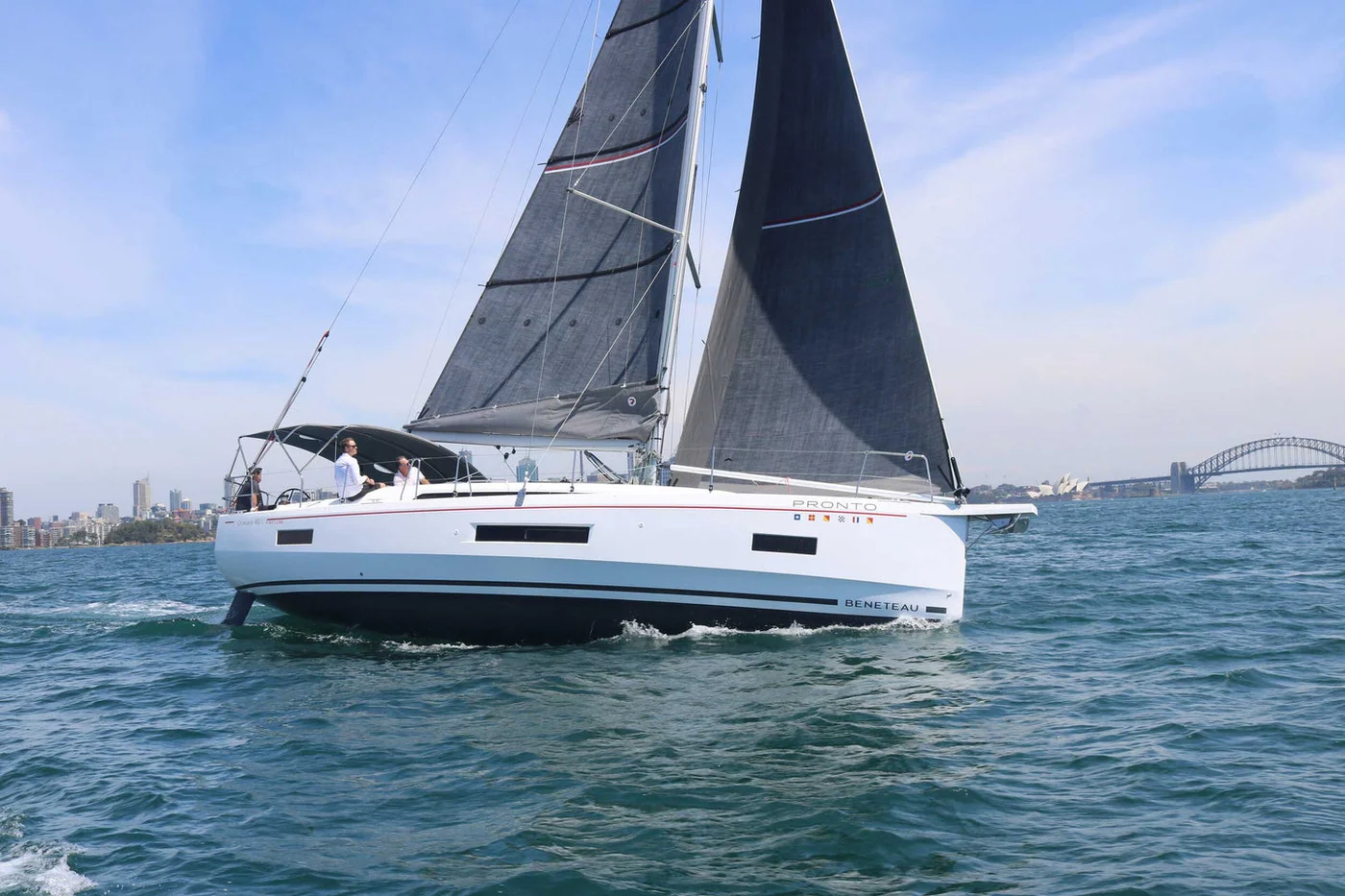

Sam Newton, Managing Director, Australia. The Australian team helps owners specify cruising and racing sails.
What's the story behind Rolly Tasker Sails? The business started in Australia in 1949 and has grown into an international sailmaking operation. How did it all begin, and how has the company evolved?
The story of Rolly Tasker Sails is tied directly to our founder, Rolland (Rolly) Tasker, one of Australia’s most celebrated ocean racers and pioneers of modern yacht racing. Rolly’s obsession with sailing began way back in 1932 in Western Australia at just 6 years of age. By age ten, he had already built his first sailing dinghy and handmade its sails.
In 1949, with a vision to provide high-quality, reliable, and affordable sails for fellow sailors, Rolly launched his business in Claremont, Western Australia. From a tiny shop with just $500, the brand evolved into one of the largest independent sailmaking operations in the world.
Rolly wasn’t just a businessman, he tested his own gear under the toughest conditions. Over his 60-year competitive career, he sailed over 340,000 nautical miles, won more than 2,000 races, and claimed Australia's first-ever Olympic sailing medal (Silver in 1956). Remarkably, due to his rigorous craftsmanship, Rolly never retired from a single race due to sail, spar, or gear failure. His unmatched technical reputation made his sails highly sought after globally.
Rolly Tasker was an extraordinary sailor, winning an Olympic silver medal in 1956 and competing in some of the world's toughest offshore races. How much of his philosophy still influences the sails you produce today?
The foundational philosophy of Rolly is the blueprint for how we still design and manufacture every single sail today.
Rolly was a relentless perfectionist and his spirit directly influences our operations through three core pillars - the ultimate balance of top quality and fair pricing, bullet proof offshore reliability and merging Rolly’s obsession with detail with 21st century technology.
Rolly started making his own sails because he believed sailors shouldn't have to overpay for excellent performance. Today, we preserve his exact blueprint to maintain a best value-for-money structure. We don't cut corners on quality, instead, we optimise our entire operation through bulk material purchasing of premium sailcloth and the latest design and manufacture technology. And by owning our own global production facilities we can keep overheads extremely low.
Next comes bulletproof offshore reliability. Because of Rolly’s heavy weather sailing pedigree, our sails are engineered for ultimate reliability. We take the heavy-duty specifications, robust reinforcing, and meticulous hand-finishing details born from Rolly’s blue-water racing years and embed them into our modern offshore cruising and club-racing sails.
And finally, merging Rolly’s obsession with detail with 21st-Century technology in sail making. Rolly Tasker was famous for his obsession with minimising weight and perfecting shapes. While he originally drafted shapes by hand or by studying raw design plans, today we carry that obsession forward using state-of-the-art SMAR Azure 3D design software and automated laser-cutters. This allows us to achieve the exact, drag-reducing aerodynamic profiles Rolly constantly chased, replicated with digital perfection across more than 2.6 million sails shipped globally.
Your team has experience across America's Cup campaigns, Sydney to Hobart races and ocean cruising. How much difference does that practical sailing experience make when helping customers choose their sails?
Practical sailing experience in events like the America’s Cup and the Sydney to Hobart, as well as competitive club and offshore events and ocean cruising, all help transform your sailmaking from a purely theoretical design exercise into a reliable, real-world solution.
Put simply, sailmakers who actively sail know how a sail behaves from the moment it is hoisted, ensuring that what looks good on a computer screen actually works under load. And while competitive racers need maximum speed, flat shapes and minimal weight, cruising sailors need ease of handling, long sail life and durable materials that withstand the elements
Your sails are manufactured at the large purpose-built loft in Phuket. How does the relationship between the Australian team and the loft work, from measuring and designing a sail through to delivery?
The relationship between the team at Rolly Tasker Sails Australia and the loft in Phuket is a highly integrated, step-by-step pipeline. Essentially, it balances local Australian expertise with state-of-the-art, large-scale offshore manufacturing.
The process moves seamlessly from initial consultation to final delivery and there are 4 main components:
Firstly, consultation, measuring and specification which we do here in Australia. This may involve research into the yachts rig and sail dimensions, using our comprehensive data-base from previous sail builds or hands-on measuring aboard the client’s boat.
Next comes sail design and modelling using advanced SMAR Azure 3D aerodynamic modelling software. Our designers visualise the 3D form, optimising the sail’s curve, camber, and wing-like shape efficiency.
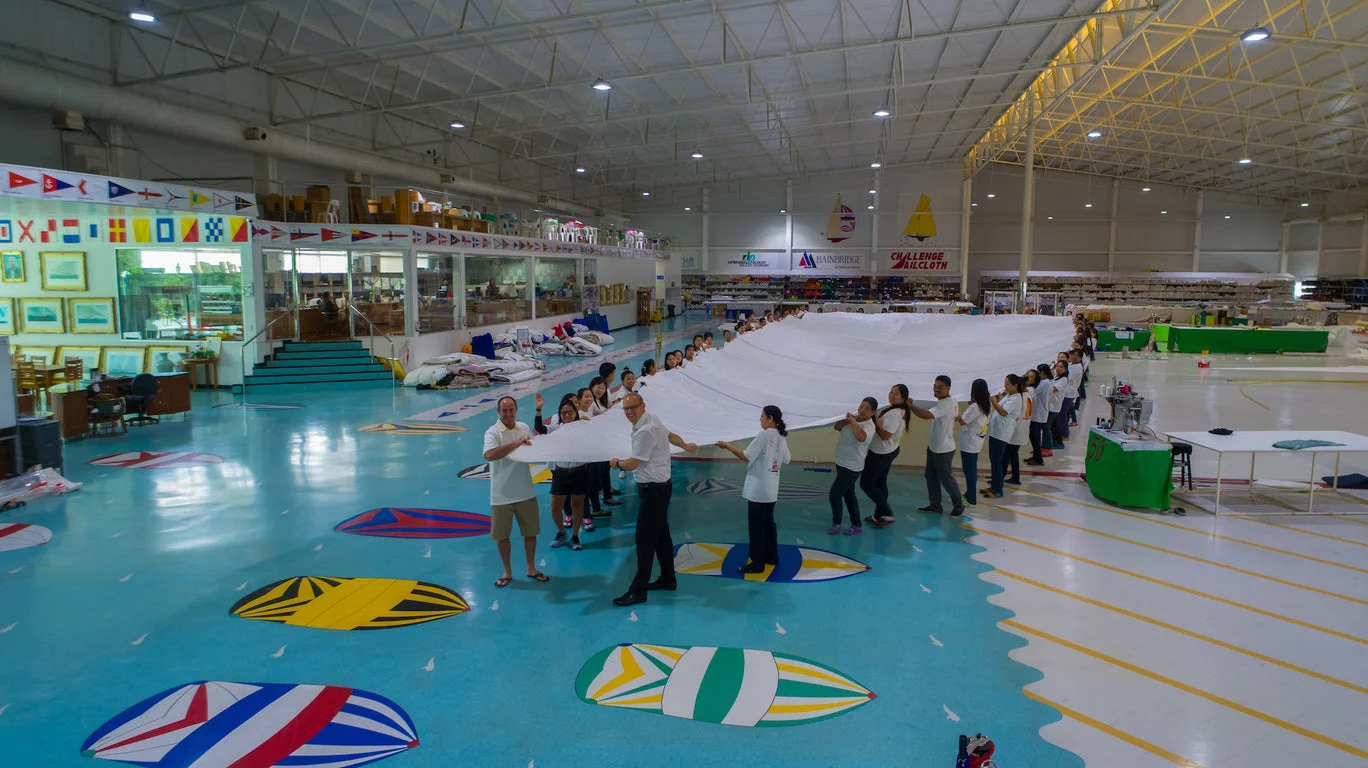
We then move to manufacturing the sail. Our loft in Phuket has massive storage capacity and sources premium sail cloth such as Challenge, Contender, Bainbridge and Dimension-Polyant, in large volume. The automated vacuum tables securely lock down the fabric while high-speed flatbed laser cutters accurately cut out panels which are then accurately hand assembled.
The final part is quality control. Once full construction is complete, a digital quality control check ensures the finished sail perfectly matches the initial physical measurements submitted by our team here in Australia. On receipt of the finished sail in Australia, we carry out a further quality check before arranging for delivery to our client.
For someone buying their first custom sail, what does the process look like? What information do you need about the boat, the rig and how the owner plans to sail?
Buying your first sail from us involves a series of steps. You start by submitting a basic quote request over the phone or by completing the quote request form on our website. One of our team will then help you pick the right cloth, sail cut and sail configuration.
Once you decide to move forward, you must provide precise dimensions. We have an extensive database of standard production boat plans, but because rigs are often modified, you may need to complete a physical measurement form. You can do this yourself using a long fiberglass tape measure, hire a local professional or if you are in a major hub like the Sydney basin, Airlie Beach or the Gold or Sunshine Coast, one of our team can do that for you.
From there all the details are input into our 3D sail-design software, the sail is laser-cut, assembled, hand-finished (such as hand-sewn leather corners for offshore sails), and shipped directly to you.
Choosing sailcloth can be confusing. Dacron, laminates, different weights and constructions. For a typical cruising yacht, what really matters when choosing the right material?
For a typical cruising yacht, choosing sailcloth comes down to balancing stretch resistance, longevity under UV and chafing, weight, and cost.
Dacron is the ultimate "set and forget" sail cloth for cruising boats. It has good UV stability and resists flogging, salt and chafing, and it can be easily repaired. On the other hand, it stretches and loses its shape gradually over time under sustained wind loads, losing its clean aerodynamic shape after a few years.
Laminates resist stretch much better, letting the boat point higher and heel less though they can be vulnerable to UV breakdown and mildew inside the film/glue layers over long offshore deployments. Cruising laminates with protective outer taffeta layers can overcome that problem.
With respect to sail cut, traditional cross-cut Dacron matches simple cross-leech loads, whereas tri-radial cut sails use engineered laminates or high-tenacity weaves to direct heavier fabric into high-stress areas and lighter fabric elsewhere to save top-weight.
Let's imagine someone has just bought a 20-year-old, 50-foot cruising yacht and wants to replace the mainsail and genoa. Where would you start, and what would you recommend prioritising?
Replacing sails on a 50-foot cruising yacht is a major financial investment and at this size the loads are immense, and poor choices can result in a boat that is exhausting to handle or underperforming.
I’d recommend starting with having a clear understanding of how you intend to use the boat – harbour sailing, coastal cruising, offshore passages or club racing – after which the rest can fall into place.
For all round cruising, premium high-modulus, tightly woven Dacron remains the gold standard. It is incredibly durable, highly UV-resistant, and can be repaired anywhere in the world with a palm and needle. If your budget allows and you want to maintain optimal sail shape over a longer period look at cruise-laminates. Avoid racing laminates, as they degrade rapidly under UV light and chafe.
For the Mainsail you have a range of batten options – leech battened, semi-battened or fully battened. For a boat of this size we’d recommend fully battened which can support a larger roach, hold a stable shape in lighter airs, dampen sail motion thus stopping destructive snapping or flapping when luffing, hoisting, or dropping, be easier to reef and to stow away in a lazy jack bag system.
For the Genoa, keep sail at a size that is manageable – around 125% to 135% still provides plenty of power while being easier to tack and furl than a full 150% overlapping sail. It’s also likely that you will often sail with a partially furled headsail. Ensure that you specify luff foam to ensure that when you reef the sail by rolling it up, the middle draft is flattened out, preserving a functional aerodynamic shape rather than turning into a baggy, inefficient sack. For a furling sail, premium UV cover to the leech and foot is essential.
How much difference can a new set of properly designed sails make to an older cruising boat? Is the improvement mainly in speed, or does it also make the boat easier and safer to handle?
A new set of properly designed sails makes a dramatic difference to an older cruising boat, improving both performance and safety. Old sails stretch and the deepest part of the sail draft drifts too far back toward the leech. New sails hold a crisp, forward-oriented draft that converts wind power into forward drive rather than drag. The result is that new sails generate clean lift and keep the boat moving and allowing the boat to sail closer to the wind.
Other benefits can include less heeling and reduced weather helm as flatter, modern sails depower easier and cause the boat to stand up taller and heel less.
You offer everything from mainsails and genoas to Code Zeros, spinnakers and storm sails. For someone planning several years of coastal cruising around Australia, what would you consider the ideal sail wardrobe?
For multi-year coastal cruising around Australia—where you face shifting tropical monsoons, trade wind runs, and strong southerly busters—the ideal sail wardrobe balances durability, easy handling for a small crew, and versatility across diverse wind angles. Let’s look at what we’d consider an optimum wardrobe of 7 sails that are easy to handle and cover all sailing situations that you are likely to encounter.
For the Mainsail, we’d recommend a semi or fully battened sail built to ‘offshore’ specification with 3 deep reef points to handle heavy blows.
Next comes an overlapping Genoa around 140% for lighter coastal air and moderate reaches, with luff foam and a UV strip for permanent furling on the forestay.
A working Jib around 100% would be your primary heavy-breeze and day-to-day upwind sail for winds consistently blowing 18–30+ knots.
For downwind sailing, a Code Zero or Code C, on a continuous-line furler, will fill the gap between a genoa and a spinnaker while being easy to deploy and retrieve.
Depending on how far your budget stretches, then a free flying Asymmetrical Spinnaker with a sock is ideal for broad reaching
A Storm Jib built from heavy hi-vis Dacron with hanks to suit a bare forestay or one which wraps over a furled genoa when winds exceed 35–45 knots.
And finally, a heavy hi-vis Dacron Trysail that lashes or tracks independently on the mast, to keep you moving in very heavy weather conditions without relying on a damaged mainsail.
Furling mainsails and genoas are popular with cruising sailors, but there are trade-offs. What are the advantages and disadvantages compared with traditional slab reefing and hanked-on headsails?
Furling mainsails and genoas offer convenience and safety by allowing sails to be deployed, reefed, and stowed from the cockpit, but they can sacrifice sail shape, performance, and mechanical reliability compared to traditional slab reefing and hanked-on headsails.
Put simply, furling sails can be deployed, reefed, or furled without leaving the safety of the cockpit. You can unroll exactly the amount of sail area needed for the current wind conditions, and you can roll them away neatly into the mast, boom, or stay, eliminating the need to flake, tie, or bag heavy canvas.
The disadvantage is that as a sail is rolled up, it loses its aerodynamic draft and bags out, which reduces upwind performance and increases heel. Further, if a furling line chafes through or the internal mechanism jams while the sail is deployed, it can be incredibly difficult—and dangerous—to drop the sail in a storm.
Traditional slab reefed and hanked on sails can benefit from full horizontal battens and a large roach, allowing for a perfectly trimmed, highly efficient shape. With fewer moving mechanical parts, there is very little that can break or jam and hanked-on systems make it straightforward to drop a large genoa and hoist a dedicated, heavy-duty storm jib on the forestay.
Naturally there are also some downsides especially for a cruising boat as crew must go on deck—often in rough seas—to reef the main at the mast or change down headsails, and dropped sails must be flaked onto the boom or bagged and stored below deck, taking up cabin space.
How can an owner tell when their sails need replacing rather than repairing? What are the signs that a sail has lost its shape or reached the end of its useful life?
There are many ways by which an owner knows a sail needs replacing rather than repairing. Some simple signs are –
the draft has moved aft, that is the deepest part of the sail has moved backward toward the leech, increasing drag and ruining upwind pointing ability.
the cloth develops a permanent "belly" that cannot be flattened no matter how much you adjust the outhaul, halyard, or sheet.
persistent wrinkles or cloth distortion across the sail face that do not disappear with proper trim.
you experience excessive heeling, increased weather helm, sluggish acceleration, or have to constantly adjust sail trim just to keep the boat moving.
the cloth feels stiff, papery, or thin, or it can be easily torn or punctured with your fingers.
Sails are a major investment. What can Australian sailors do to extend their lifespan, particularly with our strong UV exposure and the wear that comes from long-distance cruising?
Australian sailors can significantly extend the lifespan of their sails by strictly managing UV exposure, reducing physical chafe, and maintaining clean, dry storage. Australia’s intense UV index and the relentless nature of long-distance cruising are a sail's worst enemies, but strategic habits will protect your investment.
Sail design and materials have changed considerably over the years. Which developments have made the biggest difference, and are there any new technologies or products you're particularly excited about?
Historically, the evolution from traditional canvas to woven Dacron offered durability and low stretch, while the introduction of laminated sails using Kevlar, Carbon and Twaron fibers drastically reduced weight. Today, modern sail design and manufacture have shifted from hand-cut woven cloth and physical templates to digital engineering, 3D moulding, and high-performance composite fibres.
Here at Rolly Tasker Sails we are at the forefront of sail design and manufacture with some key features being –
We source only premium materials from manufacturers such as Challenge, Contender, Dimension-Polyant, and Bainbridge, including Dacron, Lite Skin, carbon-taped performance laminates, and Sunbrella.
We use specialised SMAR Azure design software to individually map each sail to the specific mast curve of the boat. Our nesting software then allows us to achieve high material yield and reduce waste.
We operate precision laser-cutting tables and plotters equipped with vacuum systems to hold the sailcloth steady and twin-needle sewing machines, double-sided bonding/gluing tape for camber and curve definition, and manual stapling before final stitching
We combine automated precision with hand-finished leather corners, radial patches, and inspection checks.
Finally, what’s next for Rolly Tasker Sails Australia? And what’s the one piece of advice you’d give someone preparing to spend serious money on new sails?
To better support Australia’s core sailing hubs, we have established dedicated Rolly Tasker branch offices in Northern and Southern Queensland alongside our main Sydney operations.
While long recognized as the global benchmark for affordable, bulletproof offshore cruising sails, an emerging focus is scaling One Design performance sails (e.g., Finn, Optimist, and Hobie 16 classes).
When spending serious money on a new sail inventory, it is easy to get seduced by the appeal of high-modulus, ultra-lightweight racing laminates, however, buying the wrong category of sail is the fastest way to waste money. Remember that high-performance laminated sails stretch less and make your boat faster, but they have a drastically shorter lifespan and are highly vulnerable to mildew and UV degradation.
If you are primarily a casual coastal cruiser or club racer, a premium, high-modulus woven Dacron (crosscut) or specialized hybrid woven sail will give you 95% of the usable performance but last twice as long.
Before committing to buying new sails always consult an expert like the team here at Rolly Tasker Sails. Their experience and expert advice can ensure that you make the right decision for your boat and sailing needs and thus ensure that your money is well spent.