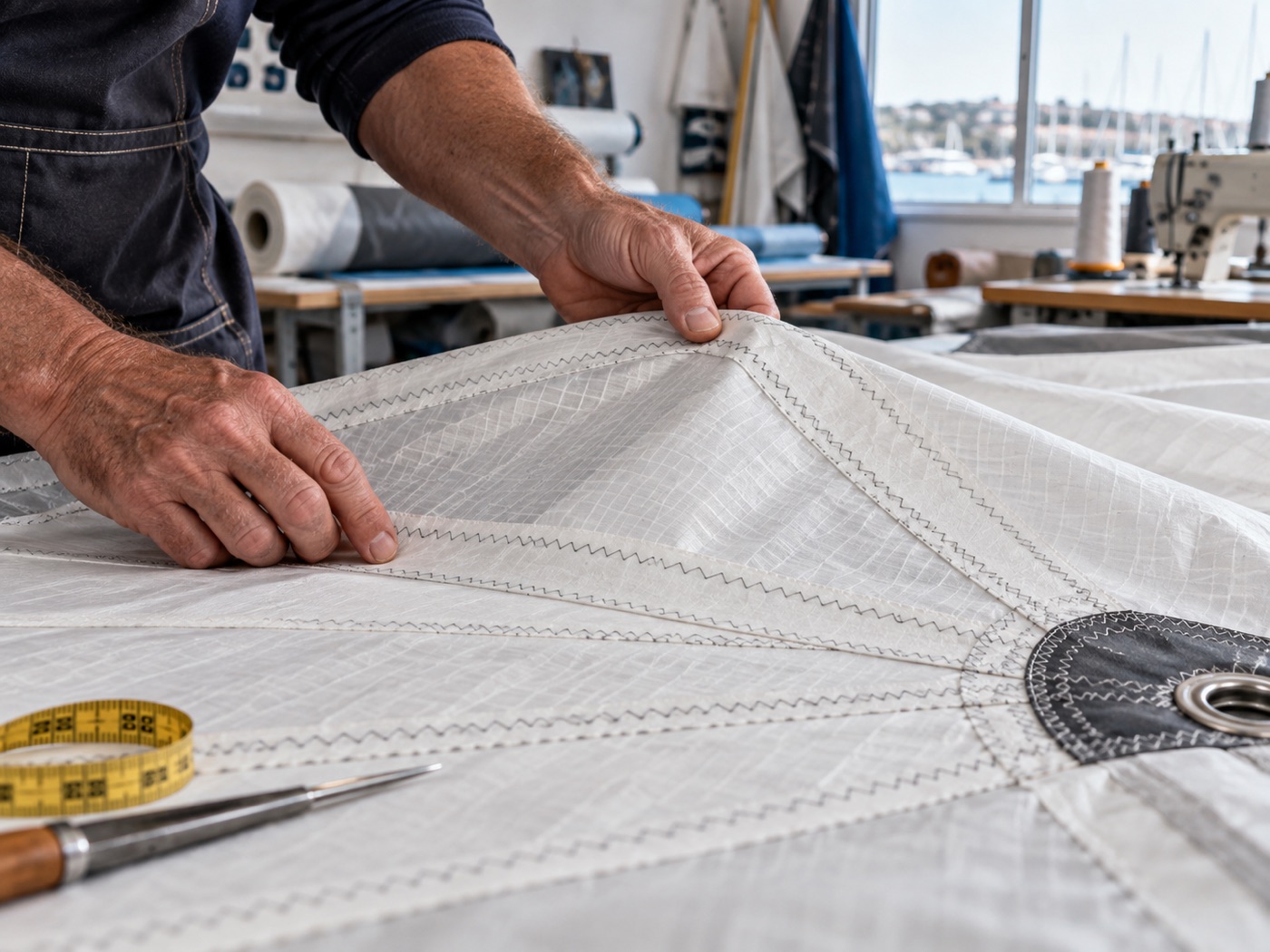
Two sails described as “radial laminate” can differ dramatically in fibre content, film stability, external protection, design quality and finishing. Compare the complete build specification.
Material families
Woven polyester
Often called Dacron, woven polyester remains the benchmark for durable cruising sails. It tolerates folding and abrasion, is widely repairable and can provide good service when the cloth weight and finish match the loads. Its limitation is gradual stretch: a sail may remain structurally sound after its designed shape has become too deep or moved aft.
High-modulus woven cloth
Modern tightly woven cruising cloths use yarn selection and finishing to improve stretch resistance without introducing film layers. They can suit owners who want a traditional, robust sail with better shape retention than basic crosscut cloth, though the finished specification matters more than the marketing category.
Laminates
Laminates combine load-bearing fibres with film and sometimes woven outer taffetas. Polyester laminates offer a relatively economical step up in shape stability. Aramid fibres are light and low stretch but require thoughtful UV and flex protection. Ultra-high-molecular-weight polyethylene fibres—commonly associated with Dyneema or Spectra—have excellent strength and flex characteristics, though creep, bonding and construction must be managed.
Composite and load-path sails
Load-path sails place fibres along calculated load directions. The result can be light and stable, with local fibre density matched to predicted loads. Performance depends on engineering, fibre choice, protective skins and manufacturing consistency. Ask what happens at reef points, corners and hardware interfaces—not only what happens across the membrane.
| Family | Strengths | Trade-offs |
|---|---|---|
| Woven polyester | Durable, forgiving, repairable | Heavier; shape changes gradually |
| Radial laminate | Good shape retention; efficient load alignment | Bonding, flex and UV exposure matter |
| Load-path composite | Low stretch and weight; engineered fibre placement | Higher cost; specialist repair and assessment |
Panel layout
Crosscut
Horizontal panels place the cloth’s strongest direction across primary loads. Crosscut construction is efficient and economical for woven polyester, especially on moderate-sized cruising sails. The cloth must be selected for the expected load; merely adding weight is not always the best route to stability.
Radial
Tri-radial or bi-radial layouts fan narrow panels from corners, aligning cloth with load paths. Radial construction can use specialised warp-oriented cloth and gives the designer more control over load distribution. It requires more cutting and seaming and should be judged on how panels, patches and reefs work together.
Load-path
Continuous or mapped fibres carry loads between corners and along the leech. Ask which fibres are structural, what external layers protect them and how the sail can be repaired locally. A transparent specification is more useful than a proprietary product name.
What quality looks like
- Design assumptions match boat weight, righting moment and intended wind range
- Corner patches transition load gradually rather than ending abruptly
- Reef points receive equivalent engineering to full-size corners
- Leech, spreader, stanchion and pulpit chafe areas are identified
- Thread, tapes and UV covers are specified for exposure
- Slides, cars, rings, furling cable and clew hardware suit existing gear
- Warranty and local service process are written and understandable
Choose by sailing program
Weekend and coastal cruising
Prioritise reliable handling, UV protection and shape life at realistic loads. A well-designed woven or cruising laminate sail can outperform an exotic but poorly matched build.
Long-distance cruising
Repairability, chafe resistance and service access become decisive. Consider external taffeta, robust corner and reef construction, conservative batten and hardware choices, and materials a distant loft can work on.
Racing
Weight and stretch targets matter more, but measurement rules, target wind range and replacement cycle should be explicit. Compare predicted flying shape and finished weight along with price.
Reviewed 14 September 2026