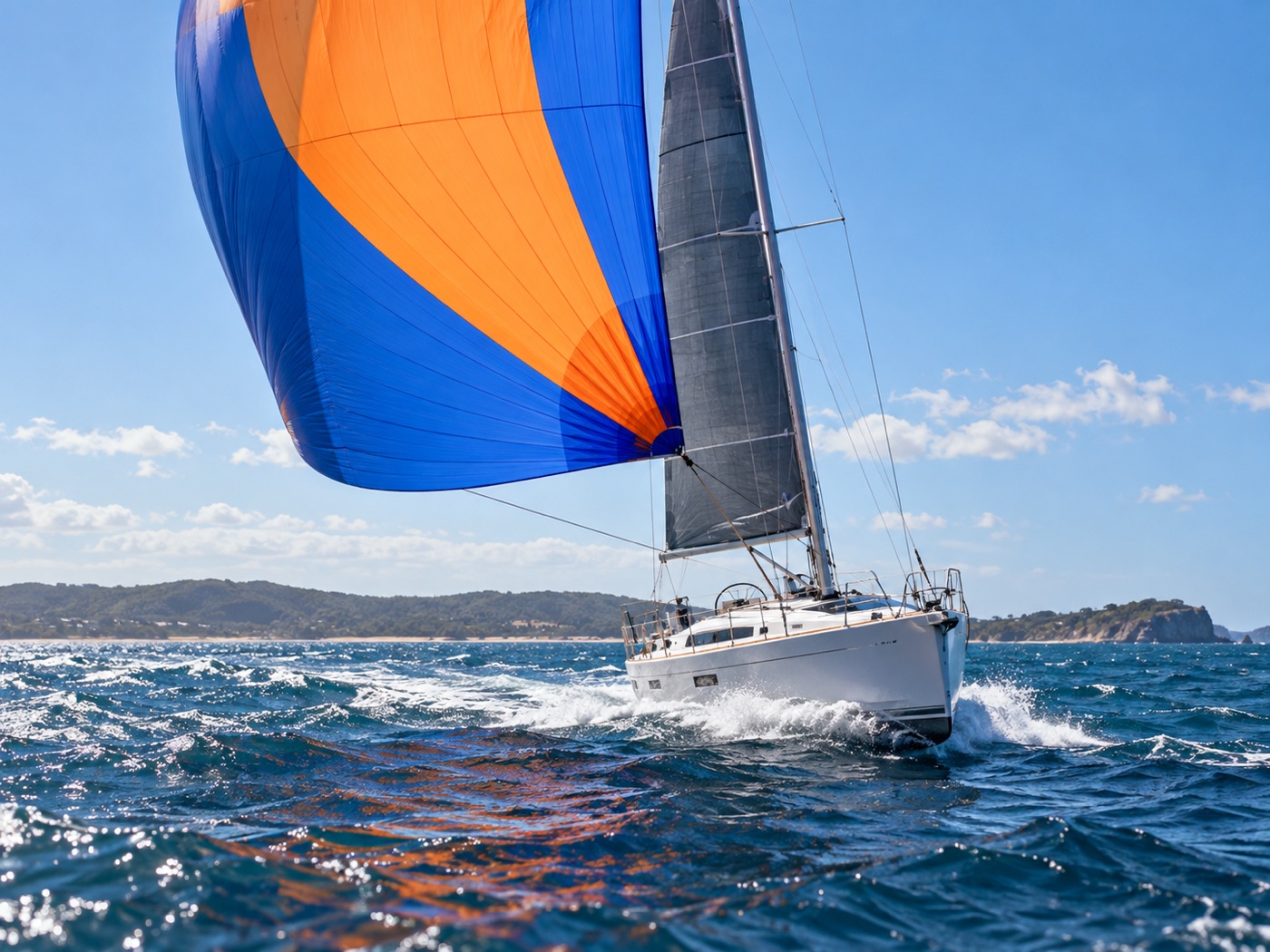
Short answer: an asymmetric cruising spinnaker with a sock is the simplest broad-use option for many cruising boats. Fast boats, deep-running programs and racing inventories need more precise shapes and crossover targets.
Symmetric or asymmetric?
Asymmetric spinnaker
An asymmetric attaches at the tack and is normally flown from the bow or a sprit. It suits reaching and broad reaching and avoids the pole choreography of a symmetric sail. A flatter shape reaches higher; a deeper, more rotated shape sails lower. “A-sail” alone is not a sufficient specification—define the intended apparent-wind-angle and wind-speed range.
Symmetric spinnaker
A symmetric sail uses a pole and can project to windward for deeper running. It remains effective on displacement boats and course formats where sailing close to dead downwind matters. The trade-off is crew work: pole height, guy and sheet management, gybing and recovery must fit the normal crew.
Cruising chute
A cruising chute is usually an asymmetric designed for forgiving trim and a broad usable range rather than a narrow racing crossover. A conservative cut, strong tapes and a reliable sock can be more valuable than extra area. Ask how the sail behaves when the wind moves forward or rises unexpectedly.
Buying a spinnaker by boat type
Cruising monohull
Choose a stable asymmetric with clear wind limits and a sock or furler the watch crew can operate. Confirm tack location, sheet leads and safe recovery.
Racing yacht
Build the sail into an inventory map. Define target AWA, TWS and crossover against other spinnakers and Code sails; avoid two sails that solve the same problem.
Catamaran
Apparent wind stays further forward as speed builds. A reach-oriented asymmetric may receive heavy luff and sheet loads; verify sprit, halyard and tack structure.
Trailer sailer
Area must match crew capacity and deck layout. A small asymmetric in a compact sock often delivers more real use than a large sail requiring complex pole work.
Sock, top-down furler or conventional launch?
A sock controls the sail from head to foot and remains intuitive for many cruisers, but needs clear hoist height and a clean control line. A top-down furler rolls an asymmetric from the head downward around an anti-torsion cable; it can simplify storage and deployment when cable length, tack swivel and sail design are matched. Conventional bag launches remain fast for trained crews and avoid the weight and cost of furling hardware.
Before buying, sketch the complete operation: where the bag lives, who raises the halyard, how the tack is controlled, where sheets lead, what blankets the sail during recovery and how the crew responds when wind increases.
Spinnaker quote checklist
- Target apparent-wind-angle and true-wind-speed range
- Symmetric or asymmetric role and inventory crossover
- Finished luff, leech, foot, mid-girth and area
- Cloth type, weight and panel layout
- Tack point, sprit projection and structural limits
- Halyard exit, masthead clearance and safe hoist
- Sheet size, lead positions and turning-block loads
- Sock, furler, torsion cable and bag inclusions
- Maximum recommended wind and recovery procedure
Reviewed 19 September 2026